Need Help?
Have an emergency? We offer emergency call out & repair

Have an emergency? We offer emergency call out & repair
Solar panels for flat roofs are a practical option for homes, extensions, offices, warehouses and other commercial properties. A flat roof does not prevent a building from generating solar electricity. On the contrary, the open area and flexible panel positioning can actually make it particularly useful for a well-planned installation.
The roof condition, mounting system, wind exposure, drainage and future access all need to be considered before work begins.
Solar panels for flat roofs can work effectively across the UK, including during cloudier parts of the year. They are normally fitted to an angled mounting system rather than laid completely flat.
Before installation, the roof should be checked for its condition, structural capacity, waterproofing, drainage and wind loading. Both domestic and commercial buildings may be suitable.
The shorter answer is yes! Solar panels on a flat roof use the same “photovoltaic technology” (fancy word for the science which turns the sun into usable energy) as panels on a pitched roof.
The main difference is instead how they are supported. A pitched roof already provides a necessary angle, while solar panels for flat roofs generally requires a purpose-designed frame to lift and tilt the panels.
This gives the installer more control over:
Domestic installs can also suit extensions, garages, dormers and modern homes.
Contrary to common belief, solar panels do not actually need constant bright sunshine. They still generate electricity on cloudy days because daylight continues to reach them, although output will, of course, be lower than under clear conditions.
The Energy Saving Trust confirms that solar panels work on cloudy days, making them a realistic option in the UK rather than something reserved for hotter countries.
Generation changes through the year. Longer summer days normally provide the strongest output, while shorter winter days produce less. A system should be judged on expected annual performance, not one grey afternoon.
For commercial buildings, daytime energy use can match the hours when panels are generating energy. At home, appliances can be used during daylight hours, while a battery may store surplus electricity for later.
The right mounting system depends on the building, roof covering, structure and exposure.
| Mounting approach | How it works | Main consideration |
| Ballasted systems | Weighted frames hold the array in place | The roof must carry the additional weight |
| Mechanically fixed | The frame is secured to the supporting structure | Fixings and waterproofing must be correctly designed |
| Low profile | Panels sit at a shallower angle | Spacing, drainage and cleaning still matter |
Angled panels can catch the wind, especially on exposed buildings and near roof edges. The layout cannot be based only on how many panels fit. The supporting structure, mounting method and local conditions all affect the design and functionality of solar panels for flat roofs.
An installation must protect the waterproofing beneath it. Poorly designed penetrations, concentrated weight or equipment placed over drainage routes can create avoidable problems.
We recommend assessing the existing flat roof system first. If the covering is near the end of its service life, renewing it before installing solar panels may prevent the array needing to be removed again soon afterwards.
Before you install solar panels, the assessment should include:
These steps help minimise the risk of leaks, overloading, weak performance and difficult maintenance.
In England, many roof-mounted solar installations fall under permitted development rights, but limits and conditions apply. Flat roof equipment may be subject to rules covering its height, position and visual impact. Listed buildings, conservation areas and unusual projects may need further approval before implementing solar panels for flat roofs.
The Planning Portal guidance on solar panels is a useful starting point, although each property should be checked individually.
Planning permission is only one part of the process. Structural safety, electrical work, fire safety and roof access also matter when you’re looking into solar panels for flat roofs.
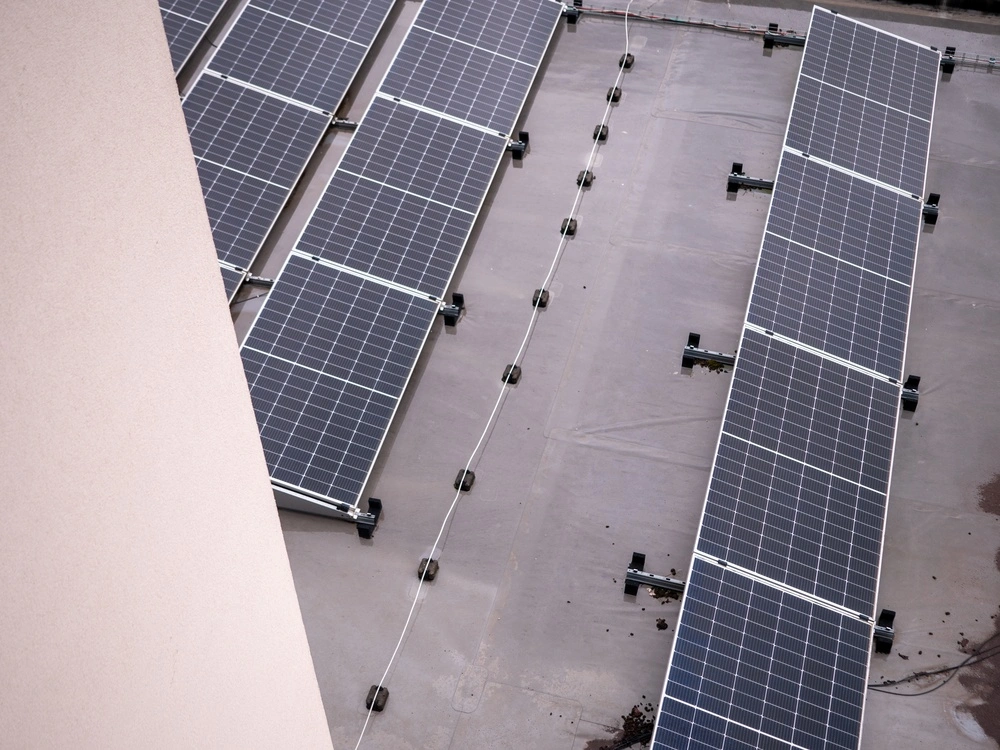
Neither roof type is automatically better. A pitched roof provides a ready-made angle whereas a flat roof offers more control over direction and layout, but requires a carefully selected mounting system.
Solar panels for flat roofs may be especially useful where the building has a large, open roof area. This is one reason flat roof solar panels are commonly considered for warehouses, offices, retail units, schools and other commercial properties.
However, more roof area does not automatically mean every part of it should be filled. Space may be needed between rows to control shading, along with clear routes to drainage outlets, rooflights, ventilation equipment and plant.
Solar panels for flat roofs can be effective on domestic and commercial properties, even with the UK’s changeable weather. The strongest installations begin with the roof itself: its condition, structure, waterproofing and drainage.
At Juniper Roofing Southern, we work across roofing and solar panel installation, allowing the roof and solar system to be considered together.
To discuss solar panels for flat roofs in East Sussex or across the South of England, contact our team today:
???? https://juniperroofingsouthern.co.uk/
???? 01323 810 555
If you liked this, you may also like: Flat Roof Waterproofing: Torch On Felt Vs Single Ply Membrane
Solar panels for flat roofs are normally tilted using a mounting frame rather than placed completely level. The best angle depends on the roof layout, panel direction and how closely the rows are positioned, so there is no single angle that suits every property.
A properly designed installation should not damage the roof covering. The mounting system must be suitable for the membrane, distribute weight correctly and avoid trapping water or placing unnecessary pressure on vulnerable areas.
There is no fixed age limit, but the roof should have plenty of useful life remaining. Installing panels over an ageing or deteriorating covering can become expensive if the entire system has to be removed for roof replacement shortly afterwards.
Rain will remove some loose dirt, but panels may occasionally need cleaning if dust, leaves, bird mess or pollution begin affecting their performance. Flat roof systems can sometimes collect more debris because they are installed at a shallower angle than panels on a pitched roof.
Yes, provided enough space is left for daylight, ventilation, maintenance and safe access. Panels should not block rooflights, outlets, vents or equipment that may need to be inspected or repaired later.
A battery can store electricity generated during the day for use later, which may help properties that use more energy in the evening. Whether it is worthwhile depends on energy consumption, system size, tariffs and how much electricity would otherwise be exported.
Many modern solar panels are designed to keep generating for 25 years or longer, although their output gradually reduces over time. The mounting equipment, inverter, roof covering and electrical components may have different maintenance or replacement timescales.
Garages and extensions can be suitable, but their structure still needs to support the additional load. Shading from the main house, trees, chimneys or nearby buildings should also be considered before deciding whether the available roof area is worthwhile.
They can make access more complicated if the array has not been planned properly. Clear walkways and accessible drainage points make routine inspections easier, while larger repairs may require some panels or mounting equipment to be temporarily removed.
It is sensible to inform your home or commercial property insurer before installation. They may ask who is completing the work, whether the system meets relevant standards and whether the roof has been structurally assessed.
Updated August 2026


Registered address: 31 Willingdon Road, Eastbourne, East Sussex BN21 1TN. Company Registration Number: 15706433.
VAT Registration number: 502034161