Need Help?
Have an emergency? We offer emergency call out & repair

Have an emergency? We offer emergency call out & repair
Your chimney sits in one of the most exposed positions on your home. Wind, rain, frost and changing temperatures all take their toll, particularly on the mortar joints holding the brickwork together. Over time, those joints can crack, crumble or wash away, which is where professional chimney repointing becomes important.
Sometimes the first warning is obvious, such as pieces of mortar appearing on the roof or loose bricks on the chimney stack. Other times, the issue is only spotted while we are inspecting another part of the roof. Dealing with deteriorating pointing early can help prevent a relatively straightforward repair from developing into something more substantial.
Chimney repointing involves removing damaged mortar from between the bricks and replacing it with fresh, suitable mortar. It helps protect the stack against water penetration, movement and further deterioration. A proper inspection should also consider the condition of the flashing, flaunching, chimney pots and surrounding roof rather than looking at the mortar alone.
Chimney repointing is not simply a case of spreading new mortar over the old joints.
Loose and deteriorated material needs to be carefully removed before the joints are prepared and filled again. The mortar also needs to be appropriate for the age and construction of the chimney, especially on older properties where very hard modern mortars may not suit the original brickwork.
The Society for the Protection of Ancient Buildings also highlights the importance of maintaining mortar joints, pots, flaunching and weatherproofing when caring for older chimney stacks.
Done properly, repointing helps strengthen the stack while improving its resistance to the weather.
You do not need to get onto the roof yourself to notice that something may be wrong. In fact, chimney inspections are best left to professionals with the correct access equipment. The Health and Safety Executive makes it clear that even short-duration roof work needs suitable safety precautions.
From ground level, signs to look out for include:
Not every one of these signs means the entire chimney needs rebuilding. In many cases, targeted chimney repairs may be enough.
There is an important difference between failed mortar and damaged brickwork.
If the bricks remain secure and in reasonable condition, repointing may be all that is required. However, loose bricks, significant cracking or movement can point towards a larger chimney stack repair rather than just a chimney repointing.
We always look at the chimney as part of the wider roof. Our roof repair and maintenance services allow us to assess whether the chimney is the only issue or whether nearby roofing materials are also contributing to the problem.
The junction between your chimney and roof has to remain properly weatherproofed. Lead flashing is used to direct rainwater away from this vulnerable area.
If the leadwork becomes cracked, lifted or damaged, water can get beneath the roof covering and cause damp around the chimney even when the brickwork itself looks sound.
That is why chimney flashing repair and repointing are often worth assessing at the same time. Fixing one issue while overlooking another may only delay the return of the leak.
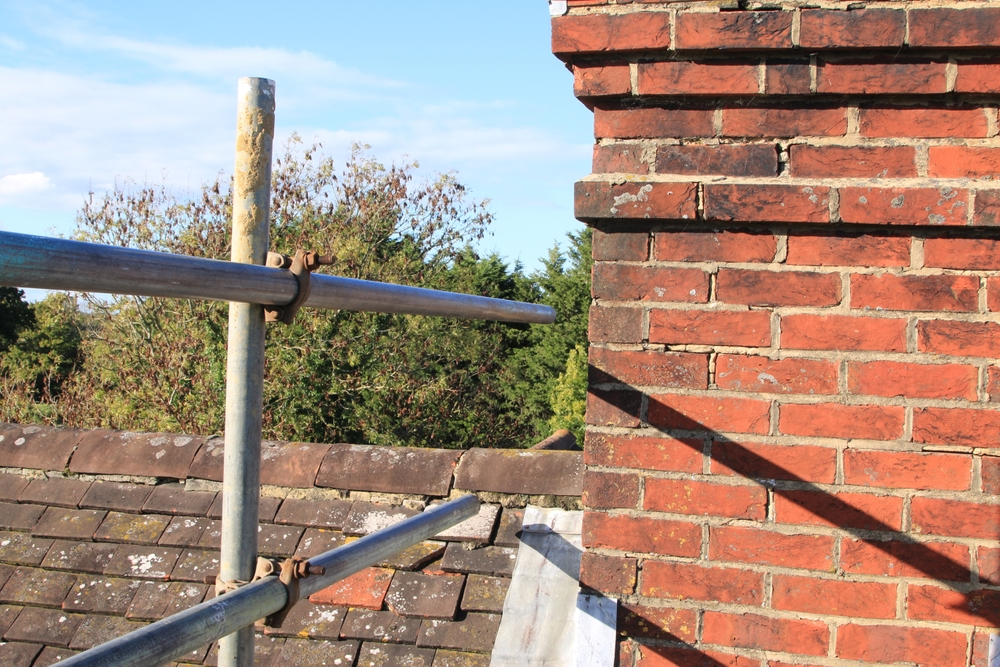
Usually, chimney repointing focuses on the external brickwork rather than the chimney flue itself.
However, the flue remains an important part of the overall chimney system, particularly where fireplaces, stoves or other combustion appliances are still in use. Government Approved Document J contains guidance covering flues and chimneys, including relevant safety requirements.
The cost of repairing a chimney depends heavily on the amount of work involved and how easy the stack is to access.
Factors can include:
A small repointing job is naturally very different from a chimney needing brickwork, leadwork and more extensive repairs.
When you search for chimney repair near me, you are usually looking for more than someone who can simply get onto the roof and apply some mortar. You need to know what has failed, why it has failed and what work is actually required.
At Juniper Roofing Southern, we place a lot of importance on good communication. Where appropriate, we use clear photographic evidence to show the condition of the chimney and the repairs being carried out, so you are not expected to simply take our word for what is happening several metres above your head.
Whether you need chimney repointing, chimney flashing repair or a more substantial stack repair, we can assess the problem and recommend a high-quality solution based on what your chimney actually needs.
If you found this interesting, you may also like: Flue Pipe and Chimney Flue: What Homeowners Need to Know
There is no fixed schedule because it depends on the age of the chimney, its exposure and the condition of the mortar. Chimneys on exposed properties may deteriorate faster than those in more sheltered locations. Periodic roof inspections can help catch failing mortar before it becomes a larger issue.
Yes, but weather conditions matter. Mortar should not generally be applied during freezing conditions, very heavy rain or when temperatures are unsuitable for proper curing. A roofer will usually choose a suitable weather window rather than carrying out the chimney repointing regardless of conditions.
A straightforward chimney repointing job may only take a day or two, although access requirements can add time. Larger stacks or chimneys with damaged bricks, flashing or flaunching can take longer. The condition of the chimney normally determines the timescale more than its size alone.
Yes, if deterioration is isolated to one elevation and the remaining mortar is still in good condition. However, all sides of the stack should be checked before deciding on the scope of work. It can sometimes be more practical to deal with several deteriorating areas during the same visit.
Exposure is one of the main reasons. Rain, frost, wind and repeated temperature changes gradually weaken mortar joints, while trapped moisture can make deterioration worse. Older mortar can also simply reach the end of its effective lifespan.
It can. Open or deteriorated joints allow more moisture into the chimney structure, which may eventually contribute to damp around the chimney breast or loft. However, flashing, flaunching, roof coverings and condensation can cause similar symptoms, so the source should be properly investigated.
Not necessarily. Individual damaged bricks can sometimes be repaired or replaced without rebuilding the entire chimney. If several bricks are loose or the stack has started moving, a more substantial repair may be required.
Yes. Chimney repointing deals with the mortar joints between the bricks, while flaunching is the mortar or concrete around the chimney pots at the top of the stack. Both can deteriorate independently, so it is common for them to be checked at the same time.
Sometimes, depending on the height, roof layout and type of repair involved. Safe access might be possible using other suitable equipment, but scaffolding is often required for larger or more involved chimney repairs. The correct access method should be determined before work begins rather than simply choosing the cheapest option.
Usually, yes. Even if the fireplace is no longer used, the chimney stack remains exposed to the weather and is still part of the structure of your property. Leaving deteriorating brickwork or mortar untreated can eventually create roofing, damp or safety problems.


Registered address: 31 Willingdon Road, Eastbourne, East Sussex BN21 1TN. Company Registration Number: 15706433.
VAT Registration number: 502034161